
Prostate-specific antigen (PSA) is a protein produced by prostate cells and is an important biomarker investigated in prostate cancer detection and monitoring. However, PSA is not specific to cancer, and elevated PSA levels can also occur in non-cancerous prostate conditions. This limitation has encouraged researchers to investigate additional and more sensitive approaches to PSA detection.
One emerging research area is the development of nanobiosensors for PSA detection.
t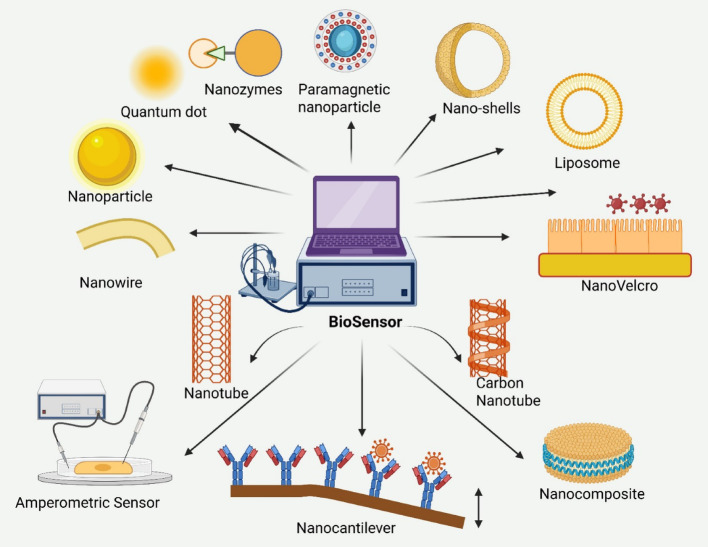
the figure above the diffrent types of biosensors
What Is PSA?
PSA, or prostate-specific antigen, is a serine protease produced by prostate tissue. PSA measurement is widely used in prostate cancer screening, but PSA levels need to be interpreted in a broader clinical context because an elevated result does not by itself establish the presence of cancer.

For an overview of PSA biosensor research, read Advances in prostate specific antigen biosensors – impact of nanotechnology.
What Are Nanobiosensors?
A biosensor combines a biological recognition element with a transducer that converts a biological interaction into a measurable signal.
Nanobiosensors incorporate nanomaterials or nanoscale structures into this sensing system. Researchers have investigated materials including gold nanoparticles, graphene and graphene oxide, carbon nanotubes, quantum dots, silica, silver nanoparticles, and magnetic nanoparticles for PSA detection.
the figure shows one example of biosensors for more details check this paper Nanomaterial based aptasensing of prostate specific antigen (PSA).
How Can a Nanobiosensor Detect PSA?
A simplified PSA nanobiosensor can be understood through four steps.
1. Biological Recognition
The sensor contains a recognition element that interacts specifically with PSA.
Researchers have investigated antibodies, aptamers, and peptides as recognition elements for PSA biosensors, as discussed in Advances in prostate specific antigen biosensors – impact of nanotechnology.
2. Nanomaterial-Based Sensor Surface
A nanomaterial is incorporated into the sensing platform.
For example, gold nanoparticles can be combined with antibodies to create a nanoscale sensing system. Research has investigated antibody-conjugated gold nanoparticles for PSA detection in serum samples.
3. PSA Binding
When PSA in a biological sample interacts with the recognition element, the interaction produces a change that can be detected by the sensor.
The exact mechanism depends on the technology used.
one exemple of binding mechanism of biosensors to PSA
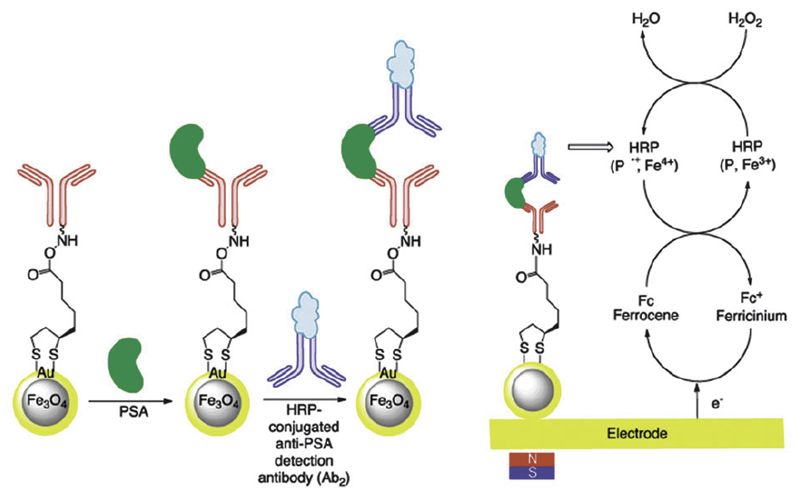
Outline of the steps required for the capture and detection of PSA using Ab1-Au@MNPs via the sandwich ELISA method. To convert the Au@MNPs into biosensors for PSA, the gold surface of Au@MNPs was covalently modified with anti-PSA antibody. The modified Au@MNPs were dispersed in a PSA sample solution to capture the PSA present in the sample. Then, an enzyme-conjugated anti-PSA antibody was added and a magnetic field was applied to bring the analyte to the transducing electrode for electrochemical sensing. Reproduced from with permission of The Royal Society of Chemistry
for more details you can read this paper
Nanomaterial-based biosensors for detection of prostate specific antigen
4. Signal Detection
The interaction is converted into a measurable signal.
PSA nanobiosensors have been investigated using electrochemical, optical, electrochemiluminescence, fluorescence, surface-enhanced Raman spectroscopy (SERS), and piezoelectric methods. These approaches are discussed in Nanomaterial based aptasensing of prostate specific antigen (PSA).
Why Use Nanomaterials for PSA Detection?
Nanomaterials can provide useful properties for biosensor development, including large surface areas and electrical or optical characteristics that can influence signal generation.
An NCBI/PubMed Central review, Nanotechnology-based biosensors for cancer detection, discusses how nanostructured materials are being investigated to improve the detection of cancer-related biomarkers.
ScienceDirect reviews have similarly examined how nanostructured materials can contribute to sensitive PSA biosensor development.
Example: Gold Nanoparticle-Based PSA Detection
One example uses gold nanoparticles (AuNPs) combined with antibodies that recognize PSA.
Researchers have developed optical sensing systems using antibody-conjugated gold nanoparticles. In these systems, PSA binding can alter the optical properties of the nanoparticle-based sensing surface, generating a measurable signal.
This illustrates how a biological recognition event can be combined with nanotechnology and optical detection.
Example: Plasmonic Nanobiosensors and PSA
Another research direction involves surface-enhanced Raman spectroscopy (SERS).
Read more SERS-based detection of prostate-specific antigen using gold nanostructures, investigated nanostructured gold surfaces for sensitive PSA detection.
Such studies demonstrate the potential of nanostructured optical platforms for biomarker research, although experimental analytical performance does not automatically translate into clinical use.
Nanobiosensors and Early Cancer Detection
One important research goal is the detection of cancer-associated biomarkers at low concentrations.
For prostate cancer, PSA provides a useful example of how biomarker detection can be connected with emerging nanotechnology. Researchers are investigating whether nanosensors can provide sensitive measurements and potentially support smaller, faster, or more portable testing platforms.
Read more here Advancements in nanobiosensors for early cancer detection, challenges, treatment, and future prospects, discusses the broader role of nanobiosensors in cancer biomarker detection.
However, high analytical sensitivity does not mean that a nanobiosensor can diagnose prostate cancer on its own. PSA is not cancer-specific, and clinical diagnosis requires additional information and evaluation.
Beyond PSA: Multiplex Biomarker Detection
An important direction in current research is moving beyond a single biomarker.
Recent research has investigated additional prostate cancer-associated targets alongside PSA, including PCA3 and microRNAs., discusses emerging biosensor approaches for multiple prostate cancer biomarkers.
The idea is that analyzing several biological signals could provide more information than relying on a single biomarker.
Nanobiosensors and Point-of-Care Research
Another potential application is the development of smaller and more portable diagnostic platforms.
Electrochemical PSA biosensors using conductive nanomaterials have been investigated because of their potential for sensitive measurements and integration into miniaturized testing systems.
Recent research reviews continue to examine miniaturization, portability, multiplex detection, and point-of-care applications as areas for further biosensor development.
What Are the Current Challenges?
Despite promising laboratory results, several challenges remain before nanobiosensors can become widely established clinical tools.
Researchers continue to investigate:
Specificity distinguishing cancer-related signals from other biological conditions.
Reproducibility obtaining consistent results between sensors and experiments.
Clinical validation demonstrating performance using appropriate patient populations and samples.
Standardization establishing consistent testing protocols.
Manufacturing producing sensors reliably at larger scales.
Cost and usability developing practical systems suitable for real-world testing.
Conclusion
Nanobiosensors for PSA detection represent an active area of diagnostic research.
By combining biological recognition elements with nanoscale materials and sensitive detection technologies, researchers are exploring new ways to measure PSA and other prostate cancer biomarkers.
Gold nanoparticles, graphene-based materials, carbon nanotubes, quantum dots, and other nanostructures have all been investigated in different PSA biosensor platforms.
The field is also moving toward multiplex biomarker detection, miniaturized devices, liquid-biopsy approaches, and point-of-care platforms.
For DXScience, PSA nanobiosensors provide a useful example of how cancer biology, biomarker research, nanotechnology, and diagnostic engineering come together to develop new approaches to biological detection.